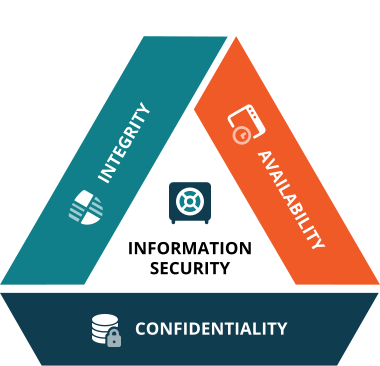
This graduate course provides a comprehensive introduction to the principles and practice of information systems security. It covers core security properties (confidentiality, integrity, availability, authenticity, and accountability) and the cryptographic primitives used to achieve them, including symmetric and public-key encryption, message authentication codes, digital signatures, and key management.
Logistics
- Semester: 2025 Spring
- Location / Time: Burchard 114 & WebCampus
- Credits: 3
- Prerequisites:
- Computer Networks
- Discrete Math, Probability and Statistics, or equivalent background
- Credits: 3
Textbooks
-
Principles of Information Security
Michael E. Whitman, Herbert J. Mattord, Cengage.
-
Cryptography and Network Security: Principles and Practice (7th edition)
William Stallings.
Additional research papers and online materials will be provided as needed.
Course Objectives
After successful completion of this course, students will be able to:
- Understand basic security concepts, techniques, policies, and standards.
- Be familiar with basic cryptographic algorithms and security protocols (for key management, secure network communication, identification, authentication, etc.).
- Learn state-of-the-art techniques related to IoT security, distributed trust, and machine learning security and privacy.
- Design and/or implement security algorithms and protocols.
Grading Policy
Total: 1000 points (100%)
- Discussion: 40 points
- Homework: 480 points (7 assignments, ~70 points each)
- Midterm Exam: 180 points
- Final Project & Presentation: 300 points
Discussion (40 points)
- Four (4) required discussions throughout the semester.
- No submission: −10 points each.
- Late submission: −5 points per discussion.
- Discussions are submitted via Canvas/WebCampus comment panel.
- Deadline: one week after the corresponding lecture; due the day before the next week’s lecture.
Homework (480 points)
- Seven (7) homework assignments.
- Each counts for around 70 points.
- Two (2) weeks to complete each assignment.
- Late penalty: −5 points per day after the due date.
Midterm Exam (180 points)
- Open-book, open-notes exam.
- Must be submitted by the due date; no makeup exam.
- Stevens academic integrity policy will be strictly enforced.
Final Project (300 points)
Format
- Individual project by default; a team of two allowed with instructor approval.
- Three possible types:
- Survey paper on a focused topic (≥ 8 pages, extensive coverage).
- Original research idea (≥ 6 pages) with analytical and/or experimental results.
- Implementation of an existing paper (≥ 6 pages) with source code and experimental results.
All reports must follow the provided IEEE template and be prepared in LaTeX.
Required sections for the final report
- Title and abstract
- Introduction (problem statement and background)
- Related work (summary of state-of-the-art and related research)
- Main technique / methodology
- Evaluation (analytical or experimental results; not required for survey-only projects)
- Discussion and future directions
- Conclusion
- References
Deliverables
- Proposal (30 points)
- 1-page PDF including: problem statement, tentative plan, team members and task allocation (if applicable).
- Mid-stage report (30 points)
- ≥ 3-page PDF with preliminary versions of Sections 1–5.
- For surveys, should cover at least half of the targeted literature.
- Final report (180 points)
- PDF in IEEE format, meeting page-length requirements (8+ pages survey; 6+ pages research/implementation).
- Include source code if applicable.
- Final presentation (60 points)
- Presentation video of at least 18 minutes per project.
- All team members must present.
- Slides should be detailed yet concise.
Grading criteria for final project
- Report quality (60 points): structure, clarity, completeness, and professional writing.
- Overall project quality (120 points): technical depth, originality, and evaluation.
Academic Integrity & Ethics
All students are bound by the Stevens Graduate Student Code of Academic Integrity. Work submitted for credit must be entirely your own; all outside assistance must be properly acknowledged. Violations will be handled according to university policy and may result in severe sanctions.
In addition, this course enforces the following penalties for identical or near-identical submissions:
- First occurrence: 50% off both submissions and a warning.
- Second occurrence: 100% off both submissions and a report to the university.
Assignments may be checked with Turnitin or similar tools for originality.
Topics (Indicative)
The detailed weekly schedule is posted on Canvas/WebCampus. Representative topics include:
- Security goals, policies, and standards
- Classical and modern cryptography (symmetric, public-key, hash, MAC, digital signatures)
- Security protocols for key management and secure communication
- Identification and authentication mechanisms
- IoT and cyber-physical system security
- Distributed trust and secure protocols in distributed systems
- Machine learning security and privacy
Last updated: May, 2025