We use cookies on this site to enhance your user experience

By clicking the Accept button, you agree to us doing so. More info on our cookie policy

NextG UAV Detection Using an O-RAN-Controlled Reconfigurable Intelligent Surface (RIS)

Published: Sep 1, 2025
Authors: Xiaochan (Luna) Xue , Shucheng Yu , Saurabh Parkar , Yao Zheng

O-RAN/AI-RAN Series

This post is part of a series all about O-RAN/AI-RAN.

Fundamental

Advanced

  • NextG UAV Detection Using an O-RAN-Controlled Reconfigurable Intelligent Surface (RIS)

On this Page

Overview

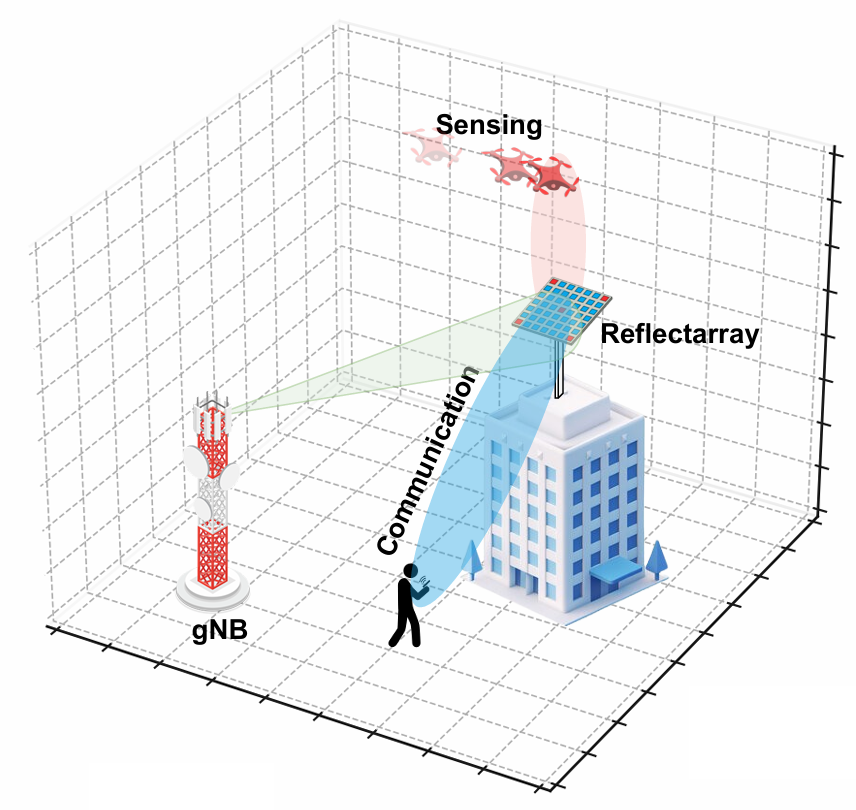
A RIS- and O-RAN–assisted Integrated Sensing and Communication (ISAC) framework is presented for high-speed UAV detection and tracking in the 3.7 GHz band. The system integrates composite OFDM–FMCW waveforms, reconfigurable intelligent surfaces (RIS), and O-RAN distributed intelligence to enable scalable, low-latency, and adaptive sensing under spectrum-sharing constraints.
Highlights

  • Joint RIS and O-RAN coordination for wide-area UAV sensing
  • Composite OFDM–FMCW waveform enabling range–Doppler detection
  • Hierarchical, state-driven sensing strategy
  • GRU-based predictive control for proactive RIS adaptation

System Architecture

  • Operation in the CBRS band (3.7 GHz) balances coverage and sensing resolution
  • RIS enhances signal observability and mitigates LoS limitations
  • O-RAN provides distributed intelligence through Near-RT and Non-RT RICs
  • ISAC enables spectrum and infrastructure sharing between sensing and communication
System Architecture
Fig. 1. System Architecture

Multi-Stage UAV Detection Strategy

A four-stage state machine governs sensing resolution and resource allocation:

  • Stage 0 – Idle
    • Continuous wide-area surveillance
    • Minimal sensing and RIS resources
  • Stage 1 – Initial Detection
    • Coarse FMCW sweeps
    • Broad beams for rapid target discovery
  • Stage 2 – Classification
    • Refined angle and velocity estimation
    • Classification between UAVs and clutter
  • Stage 3 – Identification
    • Narrow beams and high SNR
    • Fine-grained trajectory and motion characterization

State transitions depend on detection confidence, SNR, QoS constraints, and resource availability.
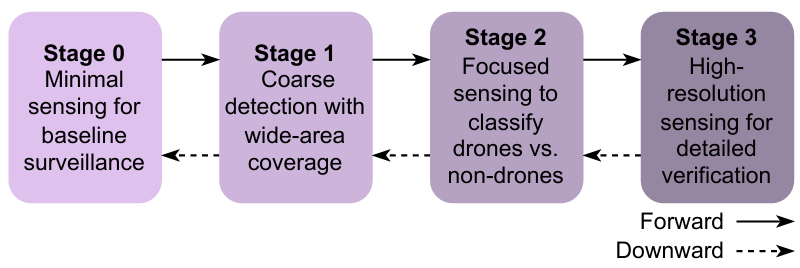
State machine for adaptive UAV sensing. Equipped with backward transitions enabled for re-verification or uncertainty handling.
Fig. 2. State machine for adaptive UAV sensing. Equipped with backward transitions enabled for re-verification or uncertainty handling.

RIS-Assisted Measurement Model

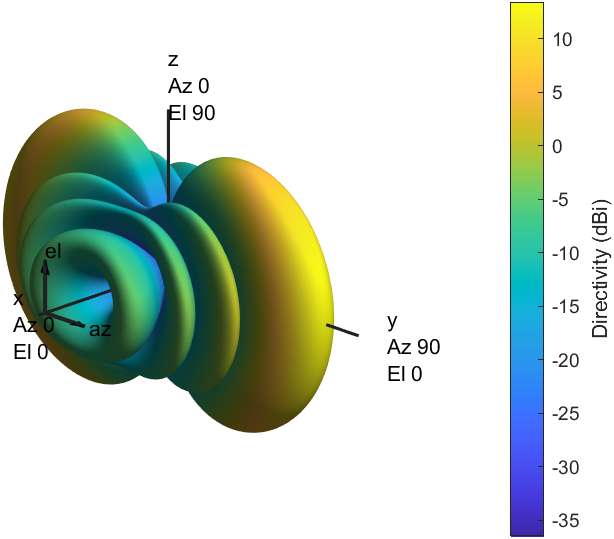
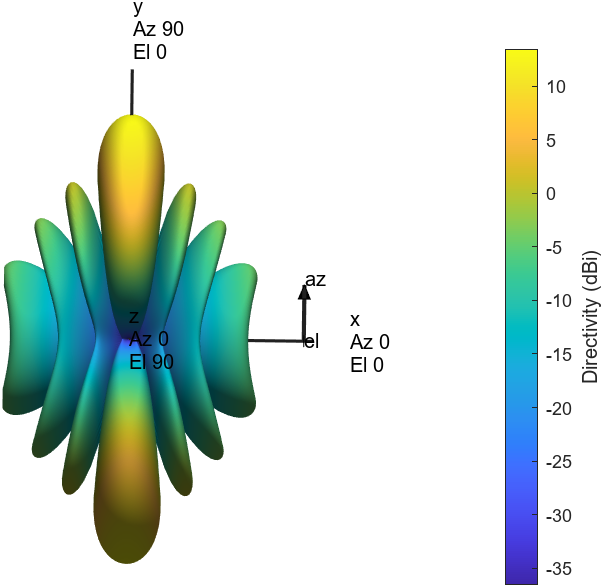
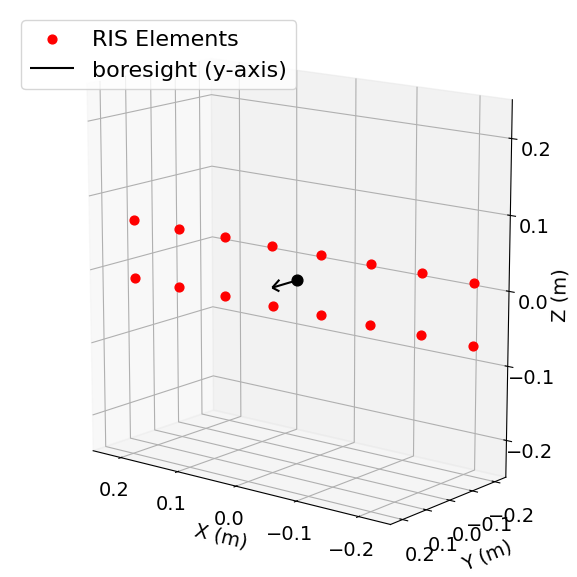
  • RIS configuration: 8x2 RIS elements array separated at $\lambda/2$ distance.
  • Sensing resource allocation managed at each stage.
  • Enables efficient trade-off between sensing precision and communication QoS
Subfigure A
Subfigure B
Subfigure C
Fig. 3. An 8x2 RIS array in 3D. Simulated directivity patterns for different azimuth/elevation combinations, illustrating beamforming capabilities.
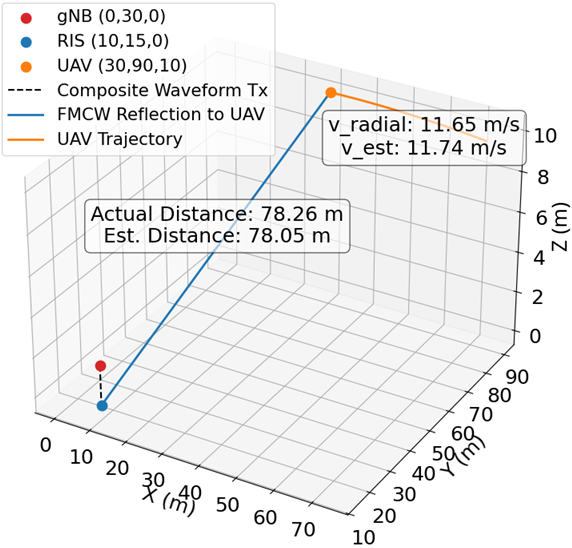
  • UAV position and velocity estimated in 3D ENU coordinates
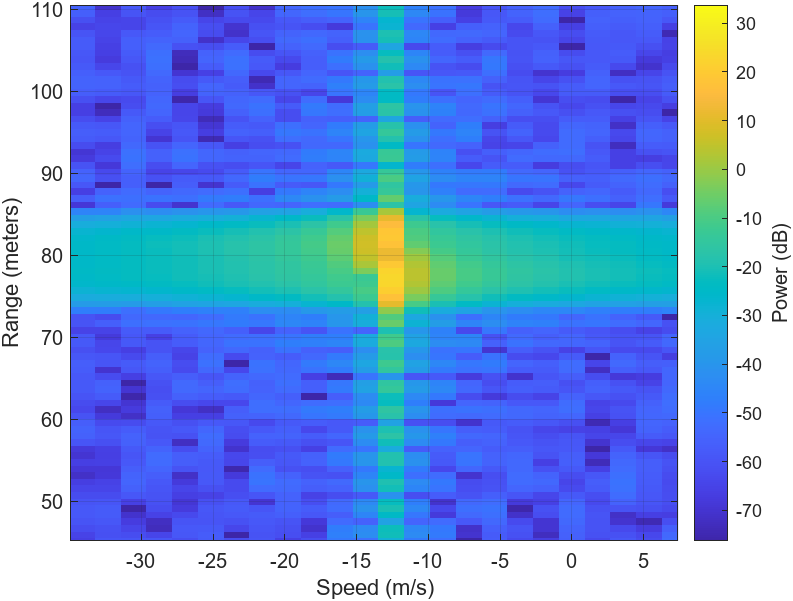
  • Range Velocity estimations
    • Beat frequency enables range estimation
    • Doppler shift provides radial velocity
  • 2D Multiple Signal Classification (MUSIC) for azimuth and elevation angles extracted via array processing
UAV trajectory in a 3D East-North-Up (ENU) coordinate system.
Fig. 5.UAV trajectory in a 3D East-North-Up (ENU) coordinate system.

Path Prediction and state change using GRU

  • SNR thresholding for UAV Detection confidence
  • Resource allocation for finer sensing
  • Gated Recurrent Unit (GRU) predicts next co-ordinate in 3D-space
    • Inputs: Co-ordinate window of last 64 CPIs
  • Prediction latency compatible with Near-RT RIC requirements
  • Enables proactive beam steering for fast UAV maneuvers
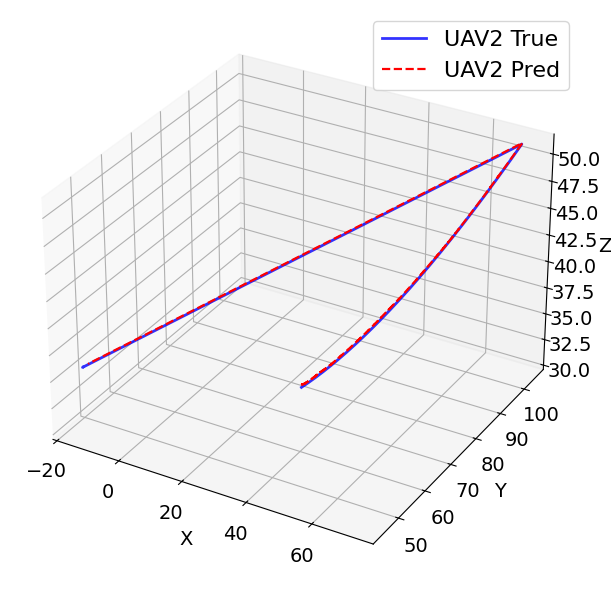
  • the GRU model achieves a training RMSE of 0.0663 and a validation RMSE of 0.1363
Subfigure A
Processed result showing range-velocity map
Subfigure B
Predicted path using GRU
Fig. 3. An 8x2 RIS array in 3D. Simulated directivity patterns for different azimuth/elevation combinations, illustrating beamforming capabilities.
O-RAN AI-RAN Prototype UAV RIS ISAC

Share

Latest Posts

O-RAN/AI-RAN Testbed

The O-RAN/AI-RAN testbed integrates commercial servers, software-defined radios, and phased-array front-ends into a flexible, programmable wireless platform. It supports a disaggregated O-RAN architecture with virtualized O-CU/O-DU, O-RU, and near-/non-RT RIC, enabling real-time data collection, AI/ML-driven control, and over-the-air experimentation. This setup allows us to prototype intelligent and secure NextG radio access networks, validate ISAC waveforms, and rapidly iterate new algorithms from simulation to hardware.

NextG UAV Detection Using an O-RAN-Controlled Reconfigurable Intelligent Surface (RIS)

A RIS- and O-RAN–assisted Integrated Sensing and Communication (ISAC) framework is presented for high-speed UAV detection and tracking in the 3.7 GHz band. The system integrates composite OFDM–FMCW waveforms, reconfigurable intelligent surfaces (RIS), and O-RAN distributed intelligence to enable scalable, low-latency, and adaptive sensing under spectrum-sharing constraints.